Orla's Story
Told by mum, Rachel
While I was pregnant with her, the ultrasounds showed a significant hole in her heart and since then a few smaller ones were found too.
Due to this, I was monitored closely throughout my pregnancy, something I am extremely grateful for but also found difficult. We found out much later that the likely cause of the heart defect was an extremely rare genetic condition called Baraitser-Winter Syndrome. This is an incredibly uncommon condition about which very little is known but often results in a congenital heart condition.
Orla was born slightly prematurely at 36 weeks, and the first few months of her life consisted of sleep and very little else. Her heart was working so hard it made her sleepy most of the time, wake windows were extremely short, and she required a tube to feed due to lacking the energy to do it herself.
Her first heart surgery
At 11 weeks Orla’s first heart surgery was performed at Glasgow Children’s Hospital, placing a pulmonary artery band in order to restrict blood flow in the wrong direction and to give her the opportunity to grow before the procedure to close some of the VSDs present in her heart. VSD stands for ventricular septal defect, a hole in the heart.
Orla recovered slowly from the surgery, remaining in PICU for 10 days after the procedure. Although she was getting better her progress was slow and we found it so difficult to see her hooked up to a ventilator for such a long time. eventually, Orla came home after two weeks in hospital.
A frightening setback
Unfortunately, we didn’t have stability for long, as Orla became extremely unwell after catching Respiratory Syncytial Virus (RSV) a couple of months later. RSV is a virus which results in cold-like symptoms but can be very serious for infants and older people.
Due to her heart condition this left her even more at risk of such a virus and we were back at Glasgow Children’s hospital. The staff could not have done a better job of looking after her, with a consultant attending at a weekend (which is uncommon) in order to place a drain to release some of the fluid surrounding her heart. The fluid could have been a build up after her surgery, or it could have been a symptom of the RSV, we will never know.
But her heart was working harder than ever, and Orla was placed under medical sedation. Her three weeks in hospital were touch and go, putting our anxiety levels through the roof and leaving us unable to hold our little girl for a full two weeks due to the fragility of her condition and the number of tubes and wires she was hooked up to. Orla was only five months old and not being able to even give her a cuddle was heartbreaking.
Eventually she started showing signs of recovery, gradually becoming stronger and eventually coming home after three weeks in hospital, just in time for Christmas.
A second chance
Orla’s second heart surgery came at 15 months old.
Prior to surgery we were asked to attend a scan so that a 3D model of Orla’s heart could be made, a new idea which our cardiac nurse had not heard of before. We were shown the model before surgery, giving us an idea of scale and just how large the main VSD was, you could fit a biro through it! Surgeons had a plan but were not certain whether they would be able to close the largest VSD until she was on the operating table. 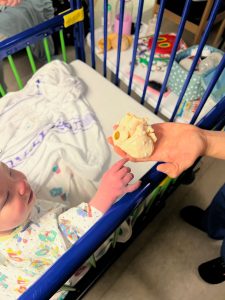
This could result in a larger band being placed and requirement for further surgical procedures. We waited tensely that day to see what they had been able to achieve, really hoping that Orla would not need to go through this for a third time.
Once surgery was complete, we were called for a post op discussion with Mr Peng, Consultant Cardiac Surgeon, who gave us the fantastic news that they had been able to close the largest VSD and remove the band; as far as they knew, no further surgery would be required! There were still a few smaller VSDs at the bottom of her heart, but these were in the muscle and should hopefully heal up themselves, now that the heart is stronger without an enormous hole in the middle of it.
What struck us first on seeing Orla was her change in colour, for the first time her hands and feet were pink instead of blue; one of the most visible symptoms of her heart condition. She bounced back in no time, coming home a week later. We could hardly believe it!
Our brave little girl
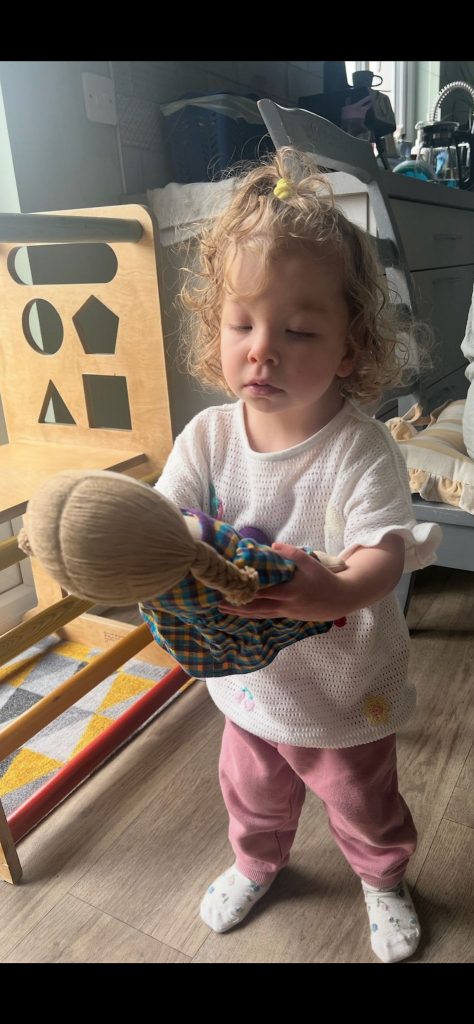
She is now an energetic whirlwind of a toddler, dancing to music being one of her favourite hobbies. We are inspired by her strength every day and love seeing her personality develop as she grows. Her Molly’s Dolly shows how strong and brave she has been, matching her scar and multiple drain sites.